Travelling with your medicines within the EU: how to carry the medicines you need correctly
9.10.2026
When travelling within the EU with medicines, the most important thing is to check in advance which medicines you are allowed to bring to your destination and what documents or certificates you need in order to carry them with you.
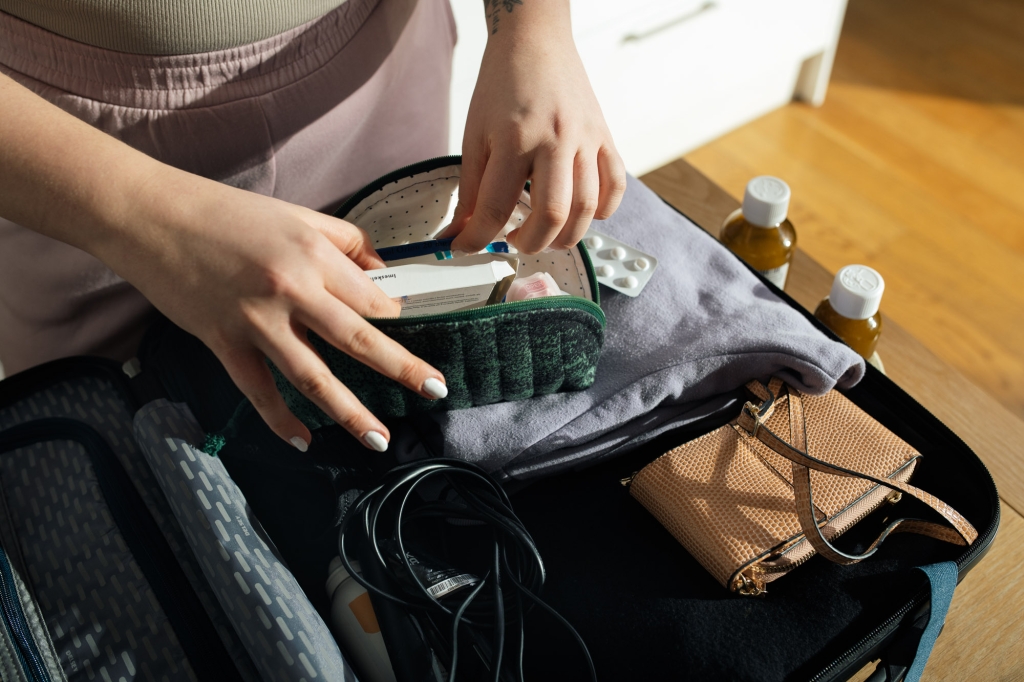
In this article, Tuuli Ainiala, an expert at the Contact Point for Cross-Border Healthcare explains how to travel with your prescription and self-administered medicines and which documents you need to bring with you when travelling in Europe.
A quick checklist before travelling abroad
- Always keep your medicines in their original packages and pack them in your hand luggage.
- If you are carrying any prescription medicines with you, please bring with you, for example, a signed copy of the prescriptions in English. You can get it from a pharmacy or the doctor.
- Consider whether you will need to bring with you information on your diagnosis or a copy of your medical history translated into English or the language of the country of destination.
- Diabetics should bring a certificate on the necessity of needles.
What medicines are you allowed to take with you when travelling abroad?
Generally, you can take any prescription and self-administered medicines you need for your own use with you on your trip.
However, practices vary from country to country: in some countries, certain medicinal substances may be banned or restrictions may be placed on the quantities that can be brought into the country. So always check in advance, before you travel, which medicines you are allowed to take to your destination.
How can I find out which medicines I’m allowed to take to my destination?
- You can check with the customs authorities at your destination to find out which medicines you are allowed to bring into the country.
- You can also ask for further information from the destination country’s contact point for cross-border healthcare or the Finnish embassy.
- There are differences between countries in the amount and type of medicines that may be brought into the country.
Remember to check the restrictions on travelling with medicines for any country you are travelling through on your way to your destination. If, for example, your journey includes a stopover in another country, it is a good idea to check that country’s restrictions as well, even if you do not leave the airport.
When do I need a Schengen certificate?
You need to have a Schengen certificate if you travel in the Schengen area and are carrying medicines that are classified as narcotics – primarily medicines that affect the central nervous system (CNS agents) – or medicines containing psychotropic substances. The Schengen certificate is to demonstrate the necessity of the medication.
- In Finland, a Schengen certificate can be obtained at a pharmacy. To obtain the Schengen certificate you must present the medicine package, the prescription and a travel document (passport or ID card).
- You can check with your pharmacy or the Finnish Medicines Agency (Fimea) whether you need a Schengen certificate for your medicine.
Frequently asked questions about travelling with medicines
Can I carry my medication in my hand luggage?
Yes – and it is usually advisable. Keep your medicines in their original packaging and take a copy of your prescription with you (preferably in English and signed by your doctor), so that you can prove, if necessary, that the medicines are for your own use.
Do I need a prescription or a certificate for self-administered medicines?
In most cases, no, if they are standard self-administered medicines for personal use. If the medicinal product is subject to restrictions or classified differently at your destination than it is in Finland, you may need to provide further information. It is therefore advisable to check import restrictions in advance.
What if there is a stopover or a change of flight in another country?
Please also take into account the rules of the transit country. Even if you do not leave the airport, some countries also apply restrictions on medicines to transit passengers.
How do I know if I need a Schengen certificate?
The easiest way to check is to ask the pharmacy. Tell them the name of the medicine and show the packaging or prescription, and they will let you know whether the medicine is covered by the Schengen certificate when travelling within the Schengen Area.
Do I need a certificate for insulin needles or other needles?
In many cases, a certificate makes security checks and border crossings easier. People with diabetes (and others who require injection therapy) should ensure they have a certificate confirming the need for needles, preferably in English.
What if I need more prescription medicine whilst abroad?
You can also buy the prescription medicine you need in other EU countries if you have a prescription issued for the purpose of purchasing medicine abroad. Ask your doctor for the prescription in advance. In some countries, electronic prescriptions are also accepted. Check the Kanta services website to see in which countries the Finnish electronic prescription is accepted.
However, you cannot, for example, buy medicines classified as narcotics whilst abroad. So please make sure you have enough of the medicine you need with you when you set off on your journey.
Ensure easy travelling with your medicines
When your medicines are packed correctly and you have the necessary prescriptions and certificates, travelling is usually hassle-free.
However, always check your destination country’s and any transit countries’ restrictions on bringing medicines into the country, keep your medicines in their original packaging in your hand luggage, and obtain a Schengen certificate if necessary. This way, you will avoid any unpleasant surprises and ensure that you can continue taking your medication safely whilst travelling.
We at the Contact Point for Cross-Border Healthcare wish you a pleasant journey!